From Gawker, a story close to my Brooklyn-born heart, literally. The Brooklyn Museum has been hosting the © MURAKAMI exhibit in which Louis Vuitton handbags designed by Japanese artist Takashi Murakami appear.
The exhibit also contains a fully functional Louis Vuitton store. Now, agent provacateur Filip Noterdaeme has decided to print flyers suggesting patrons ask for special discounts on all Murakiami-designed Louis Vuitton products. The flyers are fake - there is no discount.
What does this have to do with counterfeiting? Well... the Murakami exhibit opened this spring with actors pretending to hawk counterfeit Murakami Vittuons on a mock Canal Street set. The only different was that the bags "hawked" were real.
And what does all this prove? Maybe that conceptual art is over my head.
Check out the comments for some funny snark.
(Hat Tip: Counterfeit Chic)
Showing posts with label counterfeits. Show all posts
Showing posts with label counterfeits. Show all posts
Wednesday, 9 July 2008


Wednesday, 2 July 2008
Crime of Fashion
From the blog Fashion Intelligentsia, a writer laments her choice of internet vendors to purchase a Prada Phone only to find it was a fake. Having spent considerable money on this fake phone, the writer presses home the solid advice to talk with as many people as you can if you want to rectify a counterfeit purchase. After being initially stonewalled by the internet vendor of the phone she purchased, she contacted the Better Business Bureau, which helped pressure the vendor into a settlement.
Wednesday, 25 June 2008
The Purse Forum
The Purse Forum is an example of how online communities are popping up to help consumers discern the authentic from the fake. As detailed in this article by Amanda Kwan of the Associated Press, the Purse Forum provides a web community-based authentication service of experts - lovers and connoisseurs of luxury handbags. Registered users of the forum post pictures and details of suspected counterfeits by brand, with members of the forum providing feedback and rationale on whether the handbag in question is real or fake.
The brands discussed on the Purse Forum evoke strong feelings of loyalty, which in turn engender a dedicated community. Unpaid monitors patrol the discussions, while the community responds quickly to members seeking authenticity opinions. In addition to authentication, the Purse Forum allows its members to "show off" their handbag collection, as well as share electronic coupon codes for trusted internet retailers such as Bluefly, eLuxury, Neiman Marcus and many others.
Check out both Kwan's article and the Purse Forum for this example of an organic, community-based anti-counterfeiting initiative.
The brands discussed on the Purse Forum evoke strong feelings of loyalty, which in turn engender a dedicated community. Unpaid monitors patrol the discussions, while the community responds quickly to members seeking authenticity opinions. In addition to authentication, the Purse Forum allows its members to "show off" their handbag collection, as well as share electronic coupon codes for trusted internet retailers such as Bluefly, eLuxury, Neiman Marcus and many others.
Check out both Kwan's article and the Purse Forum for this example of an organic, community-based anti-counterfeiting initiative.
Tuesday, 1 April 2008
How to Spot Fake Fragrance & Suglasses
 The UK's Daily Mirror just alerted their readers to the dangers of counterfeits by writing a short 'How to Spot a Fake' piece in their Sunday Consumer section. The Authentics Foundation thought we'd share with you some of their tips:
"Sunglasses
Sunglasses are seen as an easy target by counterfeiters, as consumers are attracted by the promise of "designer" versions at bargain prices.
The dangers: Fake designer shades are unlikely to provide protection against UV rays, which can permanently damage your eyes.
How To Spot A Fake: Watch out for "designer" sunglasses sold unpackaged or in flimsy, unmarked plastic sleeves. Test the hinges, which are inferior in fakes, and examine the designer name - often you can just scratch it off. A lack of the peel-off certificate proving UV protection is another pointer.
Perfume
If you're planning to buy perfume, stick to trustworthy shops, chemists and department stores or look out for legitimate bargains at airports.
The dangers: Counterfeit perfume can often burn your skin or leave you with a rash. Tests on some have found them to contain urine.
How To Spot A Fake: Be wary of products with lowquality packaging, no logos, or misspelt brand names. As perfumes are highend products, they're mostly sold in reputable outlets - not from a suitcase."
Read the full story herePhoto Credit
Tuesday, 5 February 2008
Canadian Authorities Seize Counterfeit Hair Irons
 Much is done in the name of beauty. But using counterfeit hair irons to look chic on the cheap? Authorities in the Quebec City region of Canada say some consumers unwittingly did just that; the police announced a seizure of 4,500 fake hair straightening irons last Tuesday. The raid was held on January 15 after a months-long investigation beginning in March 2007.
"We have to keep in mind that everything can be counterfeit," Cpl. Richard Faucher told the Packet & Times. Faucher went on to admit that while flat irons aren't the usual seizure for his force, they must be taken seriously, as they can cause injury.
As with many counterfeit electrical products, the flat irons contained cheap, poorly made electrical connections that could "malfunction and could cause a fire.''
Even if a fake item doesn't go on the fritz, myauthentics.com warns that there are other side effects to using such products. Hair straightening irons in particular give off a great deal of heat, and counterfeit versions of these items could reach temperatures dangerously higher than company-tested products, burning the hair and skin.
Photo Credit
Monday, 5 November 2007
The Alligator Bites Back: Lacoste Ramps up Anti-Counterfeiting
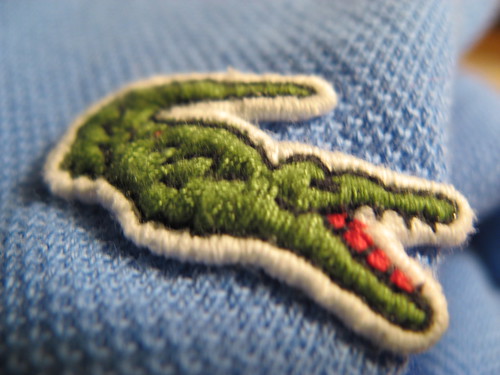 The allure of Lacoste has endured since its inception in 1933 by tennis great Rene Lacoste. Once indicating a modicum of authentic preppy style, it's now been adopted by consumers of all style preferences. As with any brand of note, Lacoste has seen counterfeits produced everywhere from Thailand to South America. In fact, the company just seized $1 million worth of phony polo shirts in Puerto Rico. Even more recently, Lacoste has increased it's focus on counterfeit production in Vietnam, where the company is working with local police in Hanoi to stamp out the problem.
One common myth concerning this alligator-embellished merchandise is that product being sold more cheaply on the internet or on the street is authentic but simply has a few "flaws" that barred it from being sold in official stores.
"With global sales of 45 million T-shirts, some errors surely occur during the production process," says Christian London, Lacoste's legal manager. "However, this volume of goods is separated and just a small part of it is sold at Lacoste shops."
As Mr. London notes, any merchandise with slight errors is sold at any number of official factory outlets Lacoste runs throughout the world, in places like New York's outlet center Woodbury Commons. Never is it cast off in such a way that it's accessible to local merchants or unofficial online vendors. Be aware that any merchandise being sold under this guise is questionable at best, and most likely counterfeit.
You can find more info on Lacoste merchandise in the e-auction world here.
Our own guide to staying away from fakes:
- Use official commercial channels. Buying the product in the store allows for warranty and guaranteed authenticity.
- Buttons: The first thing counterfeiters skimp on is price, and with it, quality. Lacoste shirts are renowned for their mother of pearl buttons. Since mother of pearl is a naturally occurring organic compound, no two buttons will ever look alike in terms of sheen and pattern. Also, authentic buttons are free from any lettering.
- Unlock the code: Official codes in your merchandise are unique. Counterfeits generally have a generic code (one such example is 8558).
- Crocodile: We have seen all manner of absurd versions of the illustrious croc, but usually consumers know the real thing when they see it. Fakes can be lopsided, pointing too far up or down, or have a number of other giveaways discussed here.
Tuesday, 23 October 2007
NY's First Counterfeit Case: It's Bad for your Health
 Women's Wear Daily has reported the first ever successful suit against a counterfeit perfume store in New York. The offending store, called Price Right and Watches is located at 1205 Broadway in Manhattan; when raided by police, it was found to house hundreds of fake fragrances bearing the marks of many name brands.
And that's not all these phony perfumes were bearing--the $3 million dollars worth of fakes are said to be a health hazard.
"Because fragrances are applied to the skin — and some counterfeits have been shown to include additives such as urine and antifreeze — fakes can pose a significant public safety issue, said Bradley Schnur, president and chief operating officer of SES and a former assistant district attorney in Brooklyn. "It's a health issue."
SourcePhoto Credit
Subscribe to:
Posts (Atom)
